Cederberg Travel Guide: Where to Go, Hike, Stay and Stargaze
Burnt-orange rock, 10,000-year-old paintings and some of the clearest night skies on Earth — here's how to do South Africa's most otherworldly mountains.

The first thing I remember about the Cederberg wasn't a mountain or a hiking trail.
It was the silence.
Driving deeper into the mountains, the vineyards and wheat fields of the Western Cape slowly gave way to something older and wilder. The roads narrowed. Cell signal faded. Sandstone formations rose from the landscape like weathered monuments. Around every bend, the scenery seemed to become more dramatic, yet somehow more peaceful.
The Cederberg doesn't announce itself in the same way as destinations like the Garden Route or Drakensberg. There are no bustling tourist towns, crowded viewpoints or long queues of visitors. Instead, there are ancient hiking trails, clear mountain rivers, remote farm stays and some of the darkest night skies in South Africa.
Located roughly three hours north of Cape Town, the Cederberg is one of the country's most rewarding outdoor destinations. It is a place where you can spend the morning hiking to a sandstone arch, the afternoon swimming in a mountain pool, and the evening sitting beside a fire beneath a sky filled with stars.
For hikers, photographers, campers, road trippers and anyone seeking a deeper connection with nature, few places in South Africa offer as much variety within a single landscape.
This guide brings together everything you need to know to plan your visit, including the best hikes, places to stay, photography locations, stargazing spots, road trip routes and local experiences that make the Cederberg so special.

Quick Facts About the Cederberg
Where Is the Cederberg?
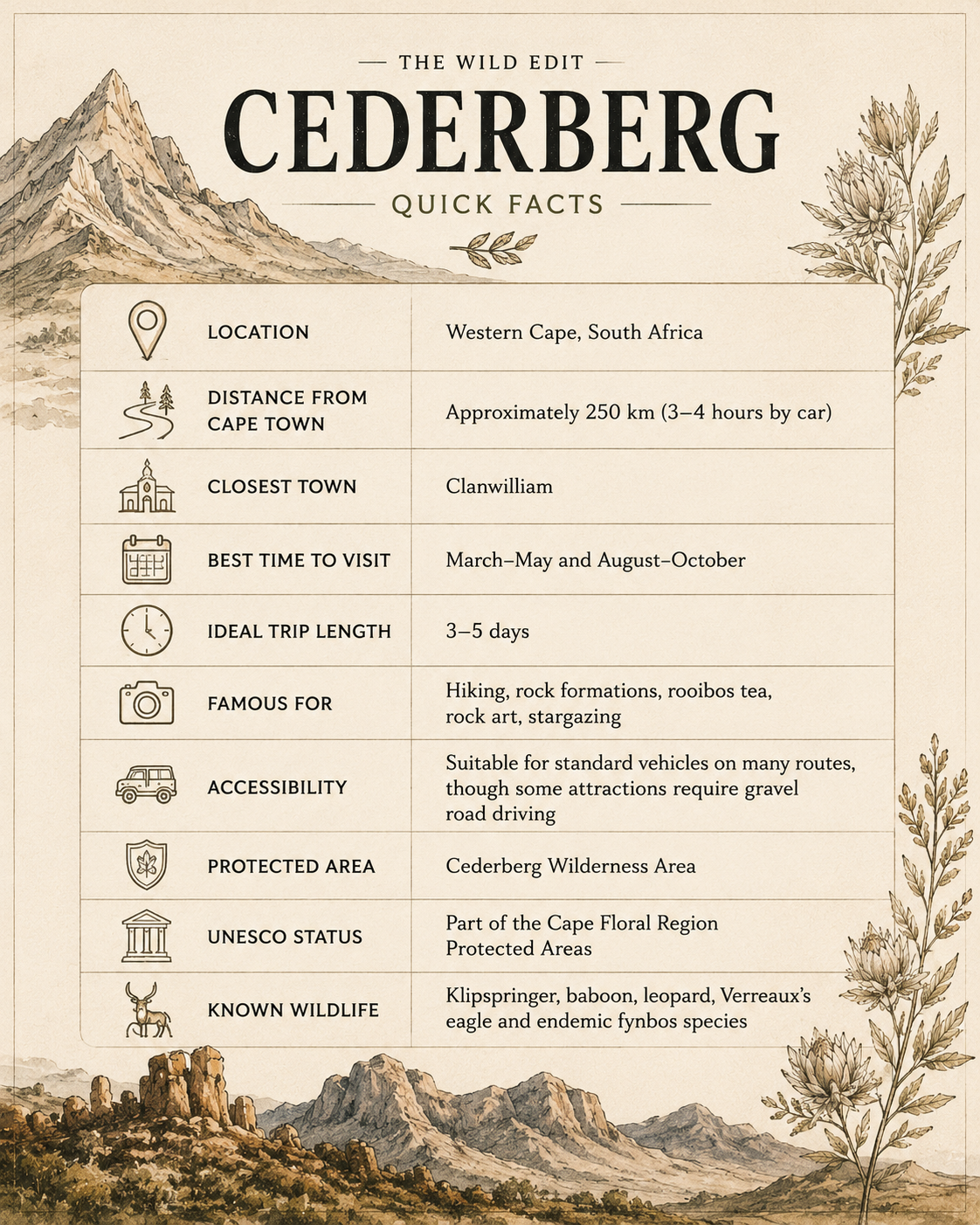
The Cederberg mountain range lies approximately 250 kilometres north of Cape Town in the Western Cape.
Most visitors access the region via Clanwilliam, the main gateway to the mountains. From there, a network of scenic gravel roads leads deeper into the wilderness towards Algeria, Sanddrif, Driehoek, Wupperthal and Rocklands.
The region forms part of the Cape Floral Kingdom, one of the most biodiverse floral regions on Earth, and is protected within the Cederberg Wilderness Area. The mountains are known for their striking sandstone formations, endemic plant species and exceptional hiking opportunities. The wilderness area alone contains roughly 300 kilometres of maintained hiking trails.
Main Areas to Explore
Clanwilliam
The main service town and starting point for most visitors. Clanwilliam offers accommodation, restaurants, fuel stations and access to the Clanwilliam Dam.
Algeria
Home to the CapeNature office and one of the main access points into the Cederberg Wilderness Area. Several hiking trails begin here.
Sanddrif and Dwarsrivier
Popular bases for hiking, swimming and exploring the central Cederberg.
Rocklands
One of the world's premier bouldering destinations.
Wupperthal
A historic mission village known for traditional craftsmanship, rooibos culture and its remote mountain setting.
Why Visit the Cederberg?
South Africa has no shortage of mountain destinations.
What makes the Cederberg different is the combination of wilderness, culture and geological drama.
Many mountain regions are beautiful. Few feel as ancient.
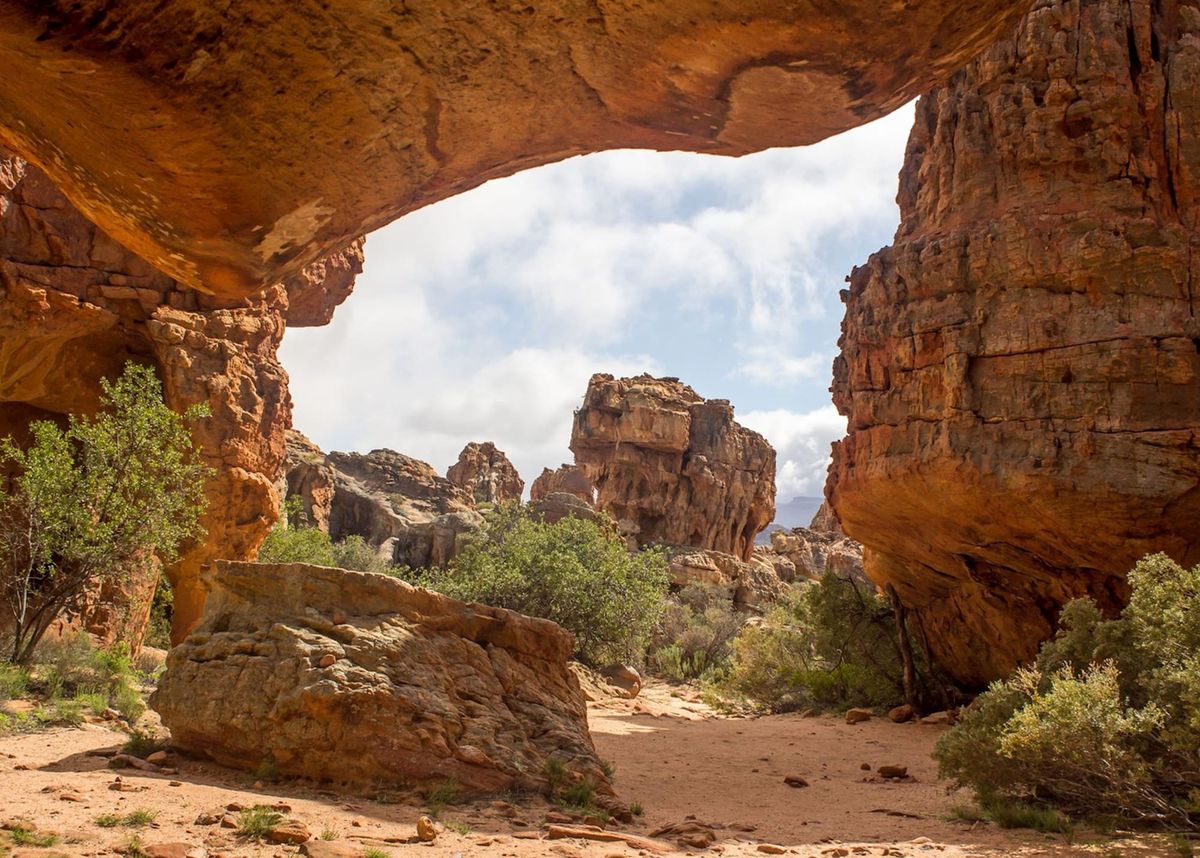
The sandstone formations that define the Cederberg have been shaped over millions of years into arches, towers, caves and sculpted rock landscapes that seem almost impossible in their scale and form.
But the mountains are only part of the story.
The region is also home to thousands of rock art sites created by San communities over centuries. More than 2,500 sites have been recorded across the broader Cederberg landscape, making it one of South Africa's most important cultural heritage regions.
Then there is rooibos.
The Cederberg is the only place on Earth where rooibos grows naturally. The rugged slopes and sandy soils create the ideal conditions for this uniquely South African plant, and the culture of rooibos farming remains deeply connected to the identity of the region.
For outdoor travellers, the appeal is equally strong.
You can:
- Hike to the famous Wolfberg Arch
- Scramble through the Wolfberg Cracks
- Swim in natural mountain pools
- Explore ancient rock art sites
- Camp beneath dark skies
- Photograph extraordinary sandstone landscapes
- Discover remote valleys and historic villages
Most importantly, you can still find solitude.
Even during peak travel periods, it is possible to spend hours on a trail without seeing another person.
That sense of space is becoming increasingly rare.
What Makes the Cederberg Different?
Every destination has a signature experience.
In the Kruger, it is wildlife.
Along the Garden Route, it is the coastline.
In the Cederberg, it is the feeling of stepping into a landscape that exists largely on its own terms.
The mountains don't reveal themselves quickly.
They reward curiosity.
A gravel road that appears ordinary can lead to an extraordinary swimming hole. A sandstone overhang may contain rock art that has survived for thousands of years. A simple farm stay can offer one of the best stargazing experiences in South Africa.
The further you travel into the region, the more the pace begins to change.
Cell signal becomes unreliable. Schedules become less important.
The days are shaped by sunrise, weather, hiking trails and campfires rather than notifications and meetings.
For many visitors, that is exactly why they return. Not because they managed to see everything. But because they didn't. The Cederberg is not a destination you tick off.
It is a place that invites you back.
Best Time to Visit the Cederberg
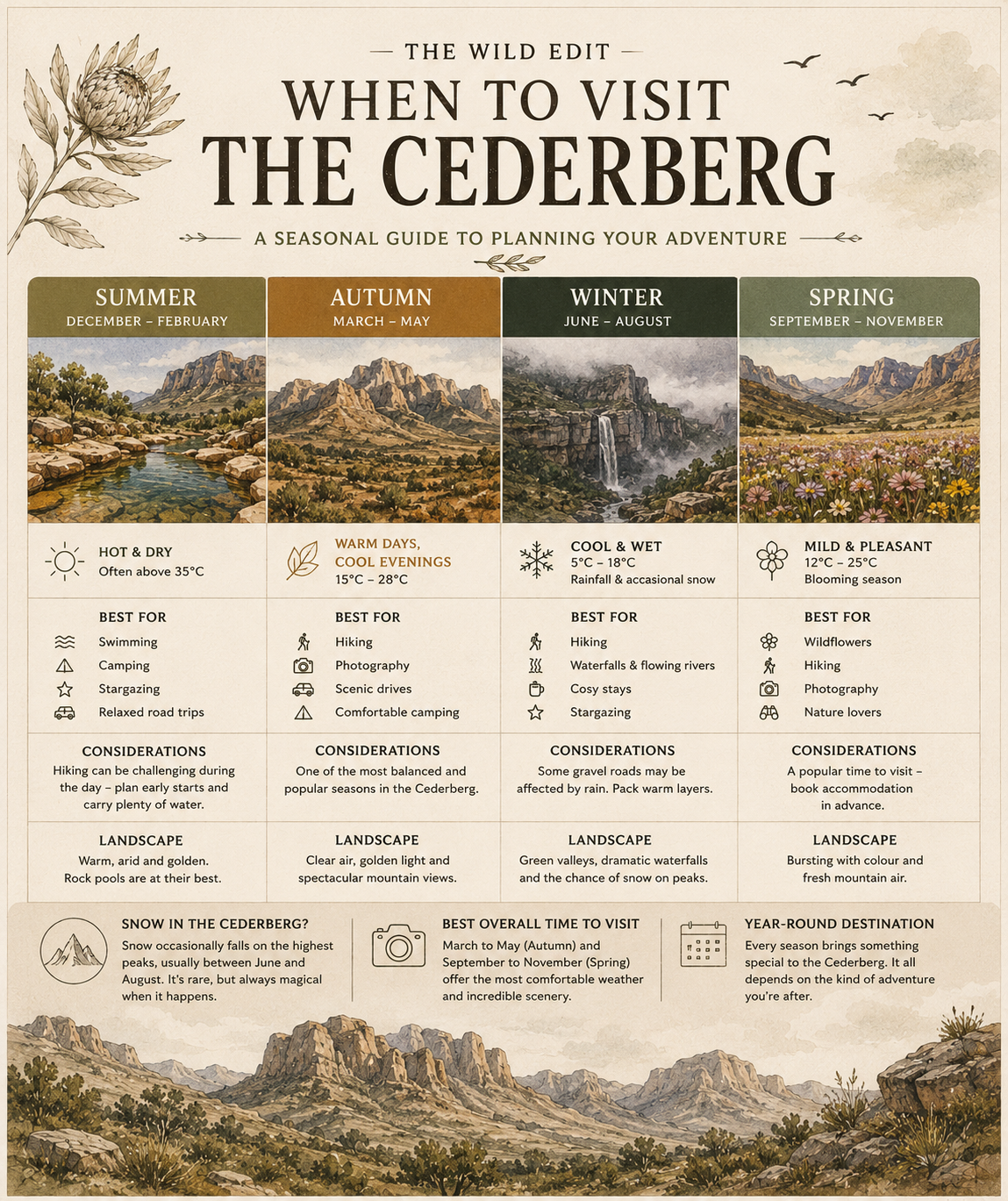
The Cederberg is a year-round destination, but the experience changes dramatically with the seasons. Summer brings long days and opportunities to swim in mountain pools, while winter transforms the landscape with waterfalls, cooler hiking conditions and, on rare occasions, snow on the highest peaks.
If your primary goal is hiking, autumn and spring are generally the most comfortable times to visit. Temperatures are mild, trails are more enjoyable, and the light is excellent for photography. Summer can be rewarding if you plan your days carefully, but temperatures regularly climb above 35°C.
Does It Snow in the Cederberg?
Yes, although not every year.
Snow occasionally falls on the highest peaks during winter, usually between June and August. The snow is rarely widespread across the entire region, but mountains such as Sneeuberg can receive a dusting after strong cold fronts.
For most visitors, winter is less about snow and more about the atmosphere. Cooler temperatures make hiking significantly more comfortable, streams flow strongly after rain, and the mountains take on a greener appearance than they do during the dry summer months.
Understanding Cederberg Weather
One of the biggest mistakes visitors make is underestimating how quickly conditions can change.
Summer days can be extremely hot, yet temperatures often drop significantly after sunset. In winter, sunny mornings can quickly give way to rain or mist in higher elevations. Regardless of the season, it's worth packing a warm layer, particularly if you're camping or planning to spend evenings outdoors.
The region's dry climate also contributes to exceptional visibility. Photographers often find that the clearest conditions occur during autumn and winter when dust levels are lower and the air feels particularly crisp.
Understanding the Cederberg Regions
One of the reasons the Cederberg feels larger than it appears on a map is that each area offers a different experience. Knowing where to base yourself can make a significant difference to your trip.
Clanwilliam & Surrounds
Clanwilliam is the gateway to the Cederberg and the logical starting point for most visitors. The town offers fuel, supermarkets, restaurants and accommodation, making it a useful place to stock up before heading deeper into the mountains.
The surrounding area is also closely linked to rooibos production, and several farms offer insight into the region's agricultural heritage.
Best for: First-time visitors, road trippers, families
Recommended stay: 1–2 nights
Algeria
Algeria serves as one of the main entrances to the Cederberg Wilderness Area. Many of the region's classic hiking routes begin here, making it a popular base for walkers and outdoor enthusiasts.
The landscape is characterised by dramatic sandstone cliffs, river valleys and indigenous vegetation.
Best for: Hiking, camping, wilderness access
Recommended stay: 2–3 nights
Sanddrif & Dwarsrivier
For many travellers, this is the heart of the Cederberg.
The area provides access to some of the region's best-known hikes, including Wolfberg Arch and the Wolfberg Cracks. It is also home to swimming spots, campsites and several highly regarded farm stays.
The scenery here feels particularly dramatic, with towering sandstone formations dominating the horizon.
Best for: Hiking, photography, camping
Recommended stay: 2–4 nights
Wupperthal
Arriving in Wupperthal feels like stepping into another era.
Surrounded by mountains and connected by winding gravel roads, the village has a rich cultural history shaped by the Moravian mission established in the nineteenth century. The journey itself is part of the experience, particularly if you travel via the spectacular Biedouw Valley.
Best for: Cultural experiences, slow travel, scenic drives
Recommended stay: 1–2 nights
Rocklands
While hikers come to the Cederberg for its trails, climbers know Rocklands for something entirely different.
The area has become one of the world's leading bouldering destinations, attracting visitors from across the globe during the cooler winter months. Even if climbing isn't your focus, the landscape is worth experiencing for its striking rock formations and expansive mountain views.
Best for: Bouldering, photography, winter travel
Recommended stay: 2–5 nights
The Wild Edit's Favourite Places in the Cederberg
After spending time in the region, it's often the smaller moments that stay with you. While iconic attractions deserve their reputation, there are certain places that capture the essence of the Cederberg particularly well.
Favourite Sunrise Spot
The high ground around Sanddrif offers some of the most rewarding sunrise views in the region. As the first light reaches the sandstone formations, the landscape shifts through shades of gold, orange and deep red.
Favourite Sunset Spot
The viewpoint near Kromrivier consistently delivers one of the finest sunsets in the mountains. The broad valleys and layered ridgelines create a sense of scale that photographs struggle to capture.
Favourite Swimming Spot
Maalgat remains one of the most memorable places to cool off on a hot summer day. The natural rock pools and sculpted sandstone channels create a setting that feels completely integrated into the landscape.
Favourite Scenic Drive
The route between Clanwilliam and Wupperthal via Pakhuis Pass reveals some of the region's most dramatic scenery. Allow plenty of time and stop often.
Favourite Stargazing Location
Almost any remote campsite in the central Cederberg will offer exceptional stargazing, but the open valleys around Sanddrif provide particularly expansive views of the night sky.
Favourite Place to Slow Down
A quiet stoep overlooking the mountains, a cup of rooibos tea in hand, and no agenda for the afternoon. The Cederberg rewards those who leave space in their itinerary.
The 15 Best Things to Do in the Cederberg
The Cederberg offers far more than hiking. While the trails are undoubtedly a major drawcard, the region rewards travellers who take the time to explore its cultural history, mountain landscapes, rivers and remote roads.
1. Hike to Wolfberg Arch
Few hikes are as closely associated with the Cederberg as Wolfberg Arch.
The route climbs steadily through rugged terrain before revealing one of South Africa's most remarkable natural rock formations. Standing beneath the arch, it's difficult not to appreciate the scale of the forces that shaped these mountains over millions of years.
The hike is moderately challenging and requires a reasonable level of fitness, but the reward more than justifies the effort.
Best for: Hikers and photographers
Allow: 5–7 hours
2. Explore the Wolfberg Cracks
For adventurous hikers, the Wolfberg Cracks provide one of the most memorable experiences in the region.
The route involves scrambling through narrow sandstone passages, climbing ladders and navigating unusual rock formations. It requires confidence with heights in certain sections but offers an experience unlike any other trail in South Africa.
Best for: Experienced hikers
Allow: Full day
3. Visit the Maltese Cross
One of the Cederberg's most recognisable landmarks, the Maltese Cross rises dramatically above the surrounding landscape.
The relatively accessible hike makes it popular among visitors who want impressive scenery without committing to a full-day trek.
Best for: Families and casual hikers
Allow: Half day
4. Discover Ancient San Rock Art
Long before hikers, climbers and road trippers arrived in the Cederberg, these mountains were home to San communities whose stories remain etched into the landscape.
The region contains thousands of recorded rock art sites, making it one of the richest concentrations of rock art in Southern Africa. These paintings offer a glimpse into spiritual beliefs, hunting traditions and daily life that stretch back centuries.
Sites such as the Sevilla Rock Art Trail and Stadsaal Caves provide some of the most accessible opportunities to experience this heritage. While the artwork itself is fascinating, what often leaves the strongest impression is the setting. Many paintings are found beneath sandstone overhangs overlooking valleys, rivers and mountain passes that have changed remarkably little over time.
Take your time when visiting these sites. They are not simply attractions but important cultural landmarks that deserve respect and careful preservation.
Best for: History lovers, photographers, families
Allow: 2–4 hours
5. Cool Off in the Cederberg's Natural Rock Pools
One of the great pleasures of visiting the Cederberg in summer is discovering the region's network of natural swimming spots.
After a morning on the trails, few things are more welcome than clear mountain water and smooth sandstone pools carved by centuries of flowing rivers.
Maalgat is perhaps the best-known example. Here, water has sculpted deep channels and pools into the sandstone, creating a landscape that feels almost designed for swimming. Numerous farm stays and campsites also provide access to lesser-known pools where you may find yourself completely alone.
The best swimming conditions are typically between November and March, although water levels vary depending on seasonal rainfall.
Best for: Families, summer travellers, campers
Allow: A few hours or an entire afternoon
6. Experience Rooibos Country
The Cederberg is the birthplace of rooibos.
While many visitors enjoy a cup of rooibos tea without giving much thought to where it comes from, spending time in the region offers a deeper appreciation for the landscapes and people behind this uniquely South African product.
Several farms and visitor experiences explore the history, cultivation and processing of rooibos. Depending on the season, you may see harvesting underway or learn how generations of farming families have adapted to the region's challenging conditions.
Even if you don't join a formal tour, simply driving through the valleys around Clanwilliam provides a glimpse into the agricultural heart of the region.
Best for: Foodies, cultural travellers, slow travellers
Allow: Half day
7. Drive Through Pakhuis Pass
Some of the best experiences in the Cederberg happen behind the wheel.
Pakhuis Pass is one of the most scenic routes in the Western Cape, winding through towering sandstone formations and opening onto expansive mountain views. The pass forms part of the route to Wupperthal and serves as an excellent introduction to the scale of the landscape.
Photographers should allow extra time for stops, particularly during the golden hours of early morning and late afternoon when the sandstone takes on rich orange and red tones.
Best for: Road trippers and photographers
Allow: Several hours with stops
8. Explore Wupperthal
Few villages in South Africa feel as distinctive as Wupperthal.
Surrounded by mountains and connected to the outside world by gravel roads, the village offers a fascinating glimpse into the cultural history of the region. The Moravian mission station established here in the nineteenth century helped shape the community that exists today.
Visitors often come for the scenery but leave remembering the atmosphere. There is a sense of quiet resilience here that reflects the landscape itself.
The journey to Wupperthal is part of the experience, particularly if you combine it with a drive through Biedouw Valley during spring flower season.
Best for: Cultural travellers and road trippers
Allow: Half day to full day
9. Go Bouldering in Rocklands
Rocklands has earned a global reputation among climbers.
Every winter, boulderers from around the world arrive to tackle problems scattered across the region's distinctive sandstone formations. Even if climbing is not your sport, the area is worth visiting for its dramatic scenery and unique atmosphere.
The concentration of world-class climbing routes has created a fascinating blend of local farming culture and international outdoor adventure.
Winter provides the best climbing conditions, with cool temperatures and dry weather.
Best for: Climbers and outdoor enthusiasts
Allow: One day or several
10. Watch the Stars Come Out
Many destinations claim to offer excellent stargazing.
The Cederberg genuinely delivers.
Once darkness settles across the mountains, the absence of major towns and artificial light allows the night sky to reveal itself in remarkable detail. On clear evenings, the Milky Way stretches across the horizon with a clarity that is becoming increasingly difficult to find.
Whether you're camping, staying in a cabin or relaxing beside a lodge fire pit, stargazing quickly becomes part of the experience.
Winter generally provides the clearest conditions, although exceptional nights occur throughout the year.
Best for: Couples, photographers, campers
Allow: Entire evening
11. Camp Beneath the Sandstone Cliffs
Camping and the Cederberg go hand in hand.
There is something particularly satisfying about waking to the sound of birdsong, stepping out of a tent and finding sandstone peaks illuminated by the first light of day.
From established campsites at Sanddrif and Kromrivier to more remote wilderness experiences, the region offers options for both first-time campers and seasoned outdoor enthusiasts.
The combination of mountain scenery, clear skies and easy access to hiking trails makes camping one of the best ways to experience the area.
Best for: Outdoor travellers and families
Allow: At least two nights
12. Photograph the Sandstone Formations
The Cederberg is a dream destination for landscape photographers.
Rock formations emerge from the mountains in shapes that often seem impossible. Towers, arches, caves and sculpted cliffs create endless opportunities for composition.
While iconic locations such as Wolfberg Arch attract much of the attention, many of the best images come from simply exploring back roads and hiking trails.
Early morning and late afternoon provide the most rewarding light, particularly during autumn and winter when the atmosphere is often exceptionally clear.
Best for: Photographers
Allow: As much time as possible
13. Explore Clanwilliam
Many visitors pass through Clanwilliam without spending much time there, which is a mistake.
As one of the oldest towns in the Western Cape, it offers a fascinating mix of history, agriculture and small-town character. The surrounding area provides opportunities to learn more about rooibos production, while the town itself offers museums, cafés and access to the Clanwilliam Dam.
It's also the ideal place to stock up before heading deeper into the mountains.
Best for: Families and first-time visitors
Allow: Half day
14. Visit During Wildflower Season
Spring transforms parts of the Cederberg.
Following winter rainfall, sections of the region burst into colour as indigenous flowers bloom across valleys and mountain slopes. While neighbouring Namaqualand tends to receive more attention, flower displays in and around the Cederberg can be equally rewarding.
The Biedouw Valley is particularly popular during this period and often attracts photographers from across the country.
Peak flowering typically occurs between August and September, although timing varies according to rainfall.
Best for: Photographers and nature lovers
Allow: Full day
15. Simply Slow Down
Not every memorable experience in the Cederberg involves a trail, viewpoint or activity.
Some of the best moments happen when you stop trying to see everything.
Spend an afternoon reading beneath a tree. Watch shadows move across the mountains. Sit beside a river with no particular destination in mind.
The pace of life here encourages a different approach to travel. Rather than rushing from one attraction to the next, the Cederberg rewards those who leave space for unplanned discoveries.
In many ways, that may be the region's greatest attraction.
Outdoor Experiences in the Cederberg
The Cederberg has long been regarded as one of South Africa's premier outdoor destinations. While hiking remains the main drawcard, the region offers far more than walking trails.
Hiking
The mountains contain hundreds of kilometres of hiking routes ranging from short family-friendly walks to demanding full-day adventures.
Popular hikes include:
- Wolfberg Arch
- Wolfberg Cracks
- Maltese Cross
- Stadsaal Caves
- Krakadouw Peak
- Lot's Wife
Most routes require permits, which can be obtained through CapeNature or participating properties.
Trail Running
The rugged terrain and extensive trail network have made the Cederberg increasingly popular among trail runners.
Cooler months between April and September provide the most comfortable conditions, while summer runners should plan early starts due to the heat.
Mountain Biking
A growing number of farms and accommodation providers offer mountain biking routes. Gravel roads, jeep tracks and quiet valleys provide excellent riding opportunities, particularly around Clanwilliam and the southern Cederberg.
Wildlife Watching
The Cederberg is not a traditional safari destination, but patient visitors are often rewarded with memorable sightings.
Klipspringers are commonly seen among rocky slopes, while Verreaux's eagles frequently soar above mountain ridges. Leopards remain elusive but continue to inhabit parts of the wilderness area.
The region's birdlife is particularly rewarding for keen birders.
Scenic Drives
Even if you never lace up a pair of hiking boots, the Cederberg is worth visiting for the roads alone.
Routes through Pakhuis Pass, Biedouw Valley, Wupperthal and the central mountain areas offer some of the most rewarding driving experiences in South Africa. Many of the best viewpoints are found simply by slowing down and taking time to explore.
Stargazing in the Cederberg
One of the greatest luxuries in modern travel is darkness.
The Cederberg offers it in abundance.
Away from Cape Town and the major towns of the Western Cape, the night sky reveals itself in remarkable detail. On clear evenings, countless stars become visible to the naked eye, while the Milky Way stretches across the horizon with extraordinary clarity.
For many visitors, stargazing becomes one of the highlights of the trip despite never appearing on the original itinerary.
Why the Cederberg is So Good for Stargazing
Several factors contribute to the region's exceptional night skies:
- Minimal light pollution
- Dry climate
- High elevation
- Low population density
- Consistently clear winter conditions
Combined, these create ideal viewing conditions throughout much of the year.
Best Stargazing Locations
Sanddrif
The broad open valleys provide unobstructed views in almost every direction.
Remote Farm Stays
Many farm stays throughout the region offer exceptional stargazing directly from your accommodation.
Wilderness Campsites
Camping allows you to experience the night sky in its fullest form, free from artificial lighting.
Wupperthal Region
The remoteness of the area creates particularly dark skies.
Best Time for Stargazing
Although excellent viewing is possible year-round, winter often provides the clearest conditions.
Moonless nights offer the best opportunities for observing the Milky Way and photographing the stars.
Astrophotography Tips
- Use a sturdy tripod
- Photograph during the new moon phase
- Arrive before dark to scout compositions
- Include sandstone formations in your foregrounds
- Dress warmly, even during summer
Exceptional Stays in the Cederberg
Accommodation in the Cederberg tends to reflect the character of the landscape itself.
Rather than large resorts, you'll find farm stays, wilderness lodges, off-grid cabins and campsites that encourage a closer connection with nature.
Many visitors discover that where they stay becomes just as memorable as the activities they undertake.
Best Luxury Escape
Bushmans Kloof Wilderness Reserve & Wellness Retreat
Perhaps the most celebrated luxury property in the region, Bushmans Kloof combines refined hospitality with extraordinary access to wilderness, wildlife and rock art.
Best for: Couples, special occasions
Standout feature: Private wilderness experiences and exceptional conservation efforts.
Best for Hikers
Sanddrif Guest Farm
The location alone makes Sanddrif one of the most practical bases for exploring the central Cederberg.
Several iconic hiking routes begin nearby, including Wolfberg Arch and Wolfberg Cracks.
Best for: Active travellers
Standout feature: Direct access to major hiking trails.
Best Farm Stay Experience
Cederberg Ridge Wilderness Lodge
Offering comfort without sacrificing a sense of place, Cederberg Ridge provides a thoughtful introduction to the region.
Best for: First-time visitors
Standout feature: Outstanding mountain views and excellent local knowledge.
Best Off-Grid Escape
Klein Krakadouw Cabins
Remote cabins scattered throughout the mountains provide opportunities to disconnect completely.
Best for: Slow travel
Standout feature: Peace, privacy and star-filled skies.
Best for Families
Kromrivier Cederberg Park
With a range of accommodation options and easy access to outdoor activities, Kromrivier works particularly well for families travelling with children.
Best for: Families
Standout feature: Swimming, hiking and open space.
Best Camping Experience
Sanddrif Campsite
Few campsites in South Africa offer such dramatic scenery combined with excellent access to natural swimming areas.
Best for: Campers
Standout feature: Maalgat swimming area and mountain views.
The Wild Edit's Suggested Cederberg Itineraries
One of the most common mistakes visitors make is trying to see too much.
The Cederberg rewards a slower approach. Rather than rushing between attractions, focus on experiencing a few places properly.
A Weekend in the Cederberg
Day One
Depart Cape Town early and arrive in Clanwilliam by lunchtime.
Spend the afternoon exploring the town and learning about the region's rooibos heritage before checking into your accommodation.
Finish the day with sunset views and dinner overlooking the mountains.
Day Two
Set out early for either Wolfberg Arch or Maltese Cross.
Spend the afternoon swimming in natural rock pools before settling in for an evening of stargazing.
Day Three
Take a scenic drive through Pakhuis Pass before returning to Cape Town.
The Perfect 3-Day Cederberg Itinerary
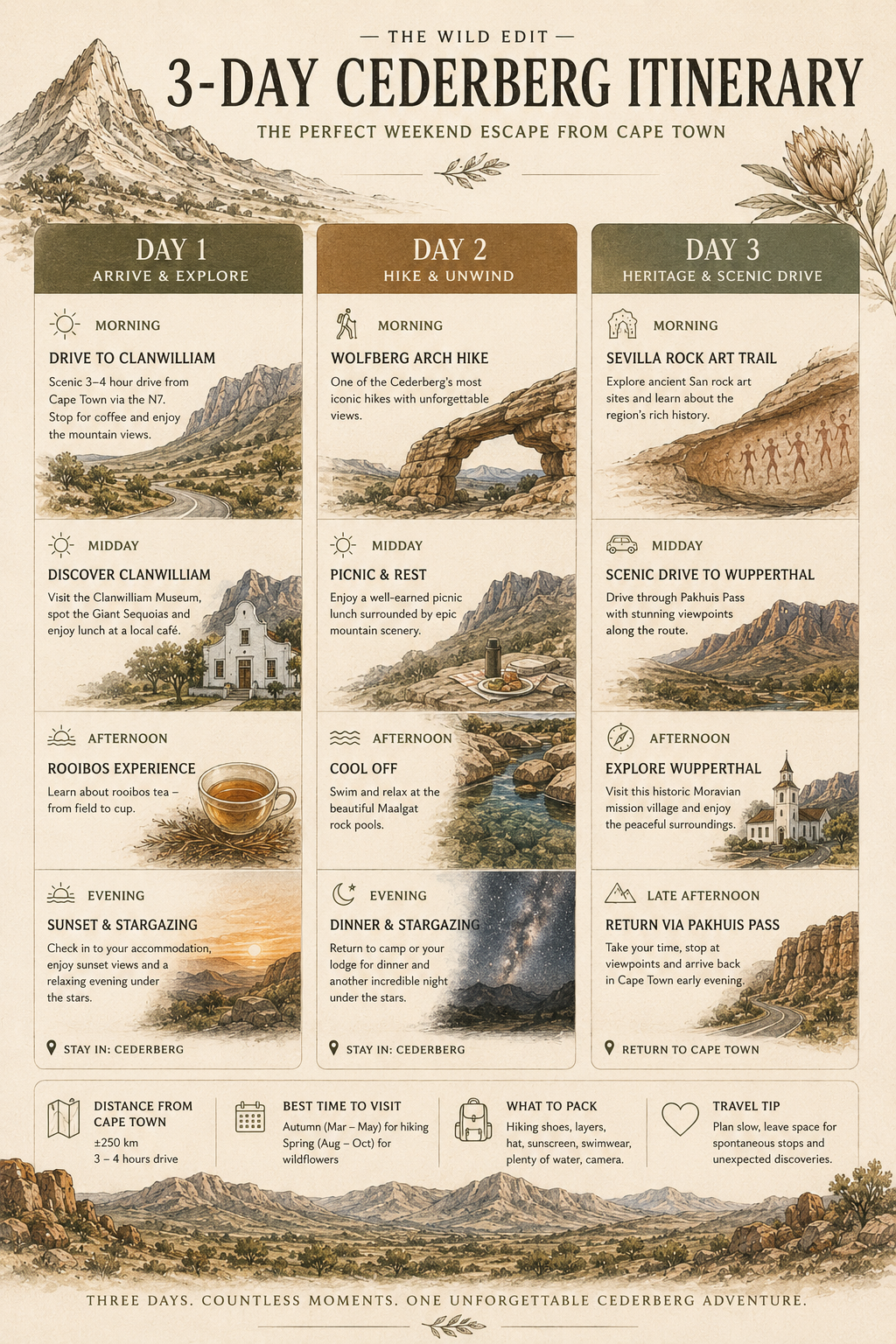
Day One
- Clanwilliam
- Rooibos experience
- Scenic drive
- Sunset photography
Day Two
- Wolfberg Arch hike
- Maalgat swimming area
- Campfire dinner
Day Three
- Sevilla Rock Art Trail
- Wupperthal
- Return journey via Pakhuis Pass
The Ultimate 5-Day Cederberg Adventure
Day One
Arrive and settle in.
Day Two
Wolfberg Arch.
Day Three
Rock art sites and scenic drives.
Day Four
Wupperthal and Biedouw Valley.
Day Five
Photography, swimming and a relaxed return journey.
Spending five days in the region allows enough time to experience both the iconic highlights and the quieter moments that often become the most memorable.
Hidden Experiences Most Visitors Miss
While Wolfberg Arch and Maltese Cross deservedly attract attention, some of the Cederberg's most rewarding experiences receive far less recognition.
Watch Sunrise Without a Plan
Rather than chasing a specific viewpoint, choose a quiet location near your accommodation and simply watch the mountains wake up.
The changing colours often provide a richer experience than any checklist attraction.
Explore the Back Roads
Many of the region's most memorable landscapes are found along quiet gravel roads rather than marked tourist stops.
Allow time for detours.
Visit During the Week
The difference between a weekday and long weekend can be significant.
Trails are quieter, accommodation is often easier to secure and the overall experience feels even more remote.
Spend an Afternoon Doing Nothing
The Cederberg's greatest luxury may be the permission it gives you to slow down.
Not every destination benefits from an empty afternoon. This one does.
Essential Travel Tips for Visiting the Cederberg
The Cederberg remains one of South Africa's more remote and undeveloped outdoor destinations. While that is a large part of its appeal, it does require a little more planning than a typical weekend away.
A few practical considerations can make the difference between a good trip and a great one.
Do You Need a 4x4?
Not necessarily.
Many of the region's main attractions, accommodations and hiking trailheads can be reached with a standard vehicle. Roads to places such as Clanwilliam, Algeria, Kromrivier and Sanddrif are generally accessible, although gravel sections are common.
That said, conditions can vary significantly after heavy rain, and some more remote farms and mountain routes may be better suited to high-clearance vehicles.
If you're planning to explore extensively beyond the main routes, it's worth checking road conditions with your accommodation before arrival.
Permits and Hiking Access
Several hiking routes within the Cederberg Wilderness Area require permits.
Depending on the trail, permits can usually be obtained through CapeNature, participating accommodation providers or designated permit offices.
Popular hikes such as Wolfberg Arch and Wolfberg Cracks often require advance planning, particularly during peak travel periods and long weekends.
Always confirm permit requirements before setting out, as regulations can change.
Fuel and Supplies
Clanwilliam is the best place to stock up before entering the mountains.
Fuel stations become increasingly limited once you head deeper into the region, particularly if you're travelling towards Wupperthal or spending several days exploring remote areas.
It's sensible to:
- Fill your fuel tank in Clanwilliam
- Carry extra drinking water
- Bring basic medical supplies
- Download offline maps before arrival
Mobile Signal and Connectivity
Many visitors consider the limited connectivity one of the region's greatest strengths.
Mobile signal is generally available around Clanwilliam and larger settlements but becomes increasingly unreliable deeper into the mountains.
Expect little or no signal in many hiking areas, valleys and remote accommodation properties.
If you need reliable internet access for work, confirm connectivity directly with your accommodation before booking.
Safety Considerations
The Cederberg is generally considered a safe destination for travellers.
Most visits are incident-free, but sensible precautions still apply.
When hiking:
- Inform someone of your route
- Carry sufficient water
- Start early during summer
- Check weather forecasts
- Avoid hiking alone on demanding routes if possible
The greatest risks tend to come from heat, dehydration and underestimating distances rather than crime.
What to Pack
The Cederberg's weather can be deceptive.
Even during summer, evenings often become surprisingly cool.
A practical packing list includes:
Summer
- Lightweight hiking clothing
- Wide-brimmed hat
- Sunglasses
- Sunscreen
- Swimwear
- Reusable water bottles
Winter
- Waterproof jacket
- Warm layers
- Beanie
- Gloves for early mornings
- Hiking boots with good grip
Year-Round Essentials
- Headlamp
- Power bank
- Camera
- Offline maps
- Basic first aid kit
Responsible Travel in the Cederberg
The region's appeal depends heavily on its natural beauty and sense of wilderness.
Visitors can help preserve that experience by:
- Staying on marked trails
- Respecting rock art sites
- Taking litter home
- Supporting local businesses
- Conserving water
- Avoiding disturbance to wildlife
Small actions help ensure future visitors experience the same sense of discovery that makes the region so special.
Frequently Asked Questions About the Cederberg
Is the Cederberg worth visiting?
Absolutely.
The Cederberg offers a combination of hiking, mountain scenery, cultural heritage, stargazing and outdoor adventure that is difficult to find elsewhere in South Africa. Its relative remoteness also means it remains quieter than many of the country's better-known destinations.
How far is the Cederberg from Cape Town?
The southern gateway to the Cederberg is approximately 250 kilometres from Cape Town.
Depending on your destination within the region and road conditions, the drive typically takes between three and four hours.
What is the best time to visit the Cederberg?
Autumn and spring are generally considered the best seasons.
March to May offers pleasant temperatures and excellent hiking conditions, while August to October brings wildflowers and mild weather.
When does it snow in the Cederberg?
Snow occasionally falls on the highest peaks during winter, usually between June and August.
While snowfall is never guaranteed, cold fronts can bring snow to elevated areas such as Sneeuberg.
Can you visit the Cederberg without a 4x4?
Yes.
Most visitors explore the region in standard vehicles. While some remote roads may be rough, many of the main attractions and accommodation options remain accessible without a four-wheel-drive vehicle.
What are the best hikes in the Cederberg?
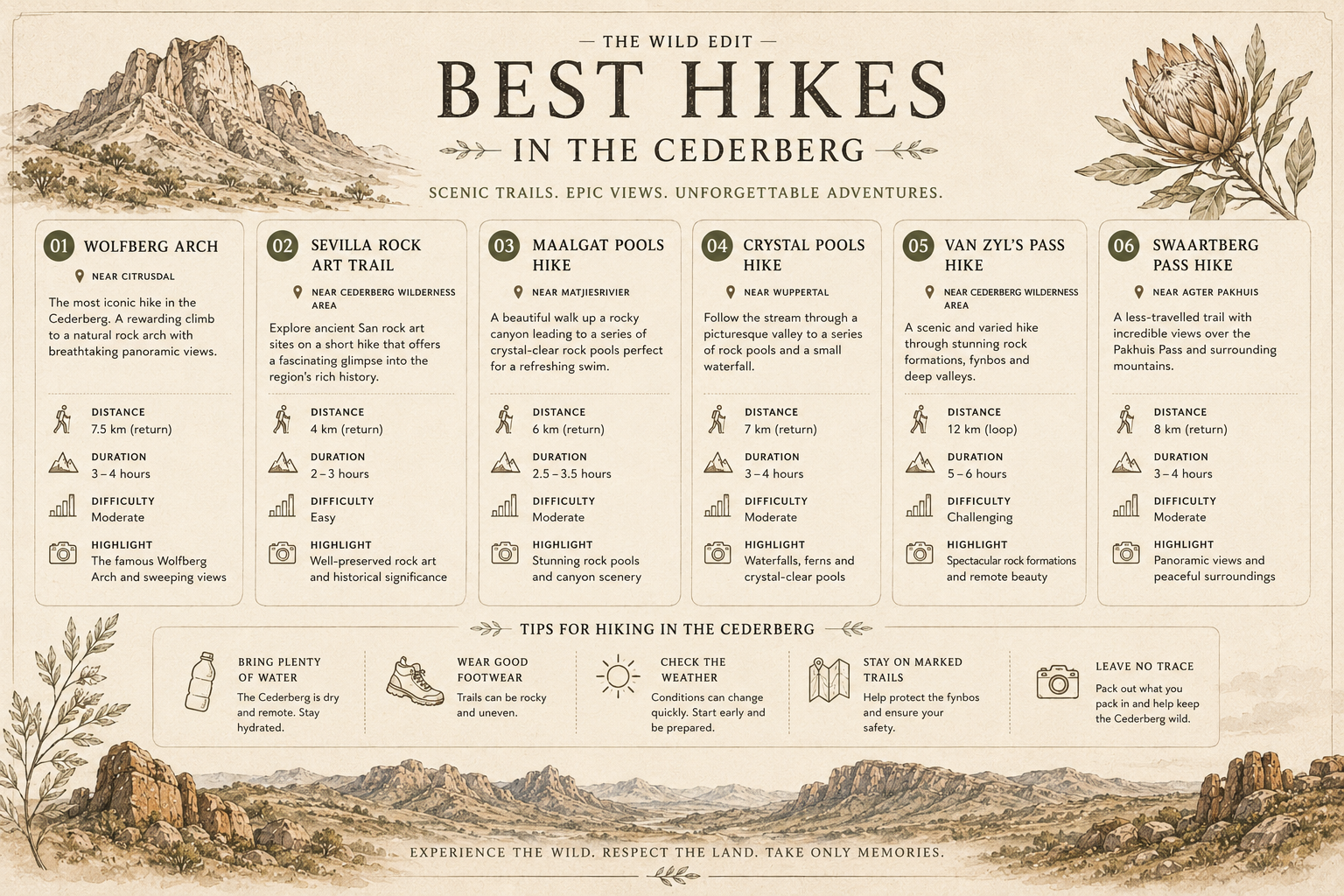
Some of the most popular hikes include:
- Wolfberg Arch
- Sevilla Rock Art Trail
- Crystal Pools Hike
- Wolfberg Cracks
- Maltese Cross
- Stadsaal Caves
- Krakadouw Peak
Each offers a different perspective on the region's landscapes.
How many days do you need in the Cederberg?
Three days provide enough time to experience several highlights.
However, five days allows for a much more relaxed exploration of the region and provides opportunities to visit less-visited areas.
Can you swim in the Cederberg?
Yes.
The region is known for its natural rock pools, rivers and swimming areas. Maalgat is among the most popular locations, particularly during the warmer months.
Is the Cederberg family-friendly?
Very much so.
Families can enjoy scenic drives, swimming spots, shorter walks, wildlife viewing and camping experiences suited to a wide range of ages.
Is the Cederberg suitable for beginner hikers?
Yes.
While routes such as Wolfberg Cracks require experience, there are numerous shorter and easier trails suitable for beginners.
What is Cederberg famous for?
The region is best known for:
- Sandstone rock formations
- Hiking trails
- San rock art
- Rooibos tea
- Stargazing
- Wilderness experiences
Are there restaurants in Cederberg?
Several lodges, guest farms and accommodation properties offer meals, while Clanwilliam provides the greatest selection of restaurants and cafés.
Can you camp in Cederberg?
Camping is one of the most popular ways to experience the region.
Options range from well-equipped campsites to remote wilderness camping experiences.
Is there wildlife in the Cederberg?
Yes, although the region is not a traditional safari destination.
Visitors may encounter klipspringers, baboons, tortoises, numerous bird species and, more rarely, leopards.
Why do people keep returning to Cederberg?
Because the experience changes with every visit.
One trip may revolve around hiking. Another might focus on photography, camping, wildflowers or simply slowing down for a few days. The region has a way of rewarding curiosity, which is why many visitors find themselves returning again and again.
Cederberg is not the kind of destination that reveals itself all at once.
At first glance, the mountains can appear harsh and unforgiving. The landscape is dry for much of the year, the roads are often rough, and many of the region's most rewarding experiences require a little effort to reach.
Yet that is precisely what gives the area its character.
The rewards are earned rather than presented. They are found at the end of a trail leading to a sandstone arch, in the stillness of a mountain sunrise, beside a rock pool on a hot afternoon, or beneath a sky crowded with stars.
Perhaps more than anywhere else in the Western Cape, the Cederberg encourages a different pace of travel. It asks you to stay a little longer, drive a little slower and leave space for unexpected discoveries.
You may arrive with a list of hikes, viewpoints and places to visit. Chances are you'll leave remembering something entirely different.
A conversation on a farm stoep. The smell of rooibos drying in the sun. The silence of a mountain valley at dawn. Those are the moments that linger.
And they are often the reason people find themselves planning a return trip long before the first one is over.
See You In The Wild